
HP120
Bulbasaur
weakness
The opponent's attacks of this type deal +20 damage.
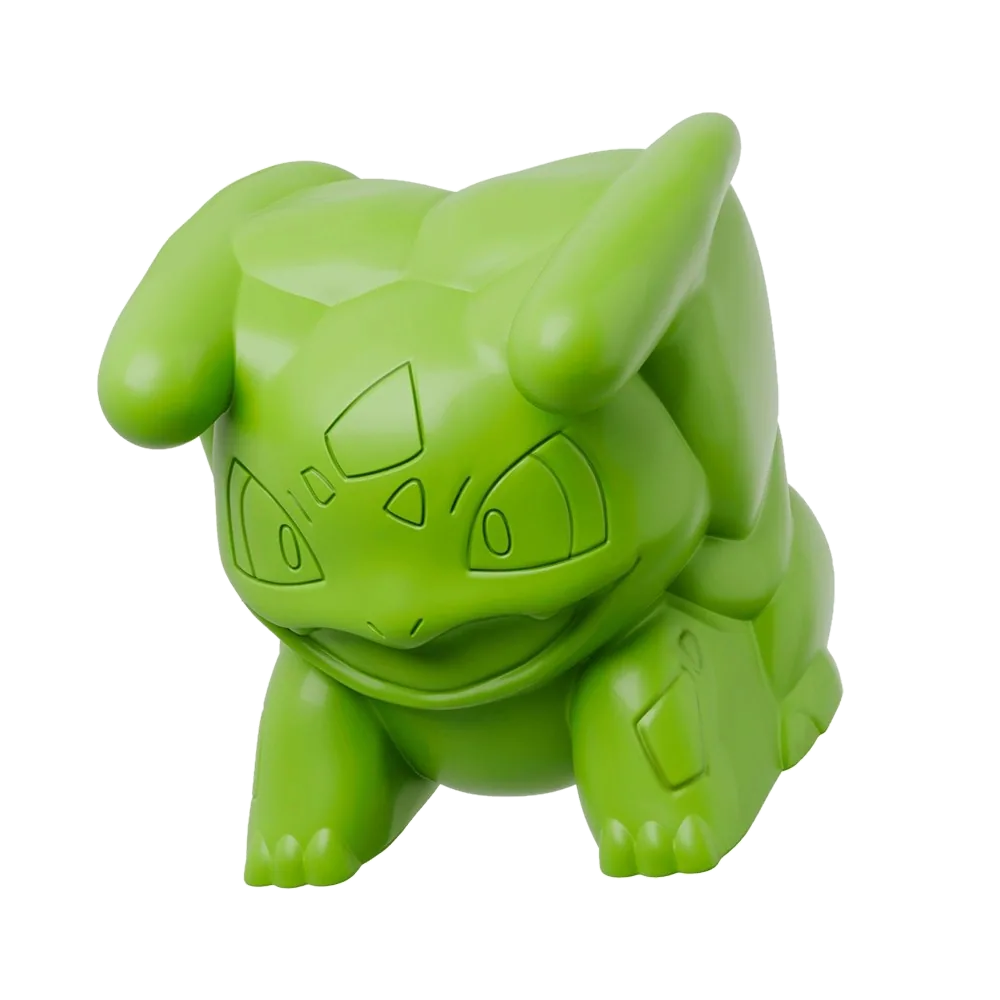 STC01-001
Rules
Both players put their Pokémon’s Charakoro and its three built Enekoro on the table at the same time.
Once they are in view you can’t change Charakoro or swap the Enekoro’s chips. That’s why they are revealed together: so nobody chooses after seeing the other’s.
The Pokémon’s data card goes face up in its slot on the mat.
HP120
weakness
The opponent's attacks of this type deal +20 damage.
STC01-001Four, not three or five, and no two can be the same. They must all be usable by your Pokémon: the card itself says which Pokémon can use it.
Bulbasaur
10 damage


 +20 damage
Every Pokémon in the game starts with 120 HP, which is what its data card says.
When you have both finished setting up, the four cards go face up. You don’t play blind: each of you knows what the other has.
Rock, paper, scissors or however you like. The winner goes first, and on their first turn rolls only 2 Enekoro instead of 3.
Choose one of your four cards and announce it out loud. You can’t pass: you have to attack.
Roll your three Enekoro (two on the first player’s first turn) and the Charakoro together, and look at the energy on each Enekoro’s top face. If they don’t all fit in your hand, you can roll them separately (question 9).
If that energy covers the card’s cost, the roll succeeds. Normal energy in the cost can be paid with any type; a specific type only with that type.
If you don’t cover the cost, the attack fails and the turn ends there: whatever the Charakoro shows doesn’t count and nothing is applied.








If the energy covered the cost, see how the Pokémon figure landed: Upright, Upside down, On its back, On its front or On its side.
Each attack card says what happens for each orientation. Many add damage; others heal, take Enekoro away from the opponent or repeat the attack.



Add the card’s damage to whatever the Charakoro effect adds, and then, if the Pokémon taking it is weak to that type, add 20 more.
The opponent takes that many HP off their life counter and it’s their turn.
Weakness applies once to the total, not to the card’s damage and the effect’s damage separately.
Each Pokémon’s data card says what type it’s weak to. If you hit it with an attack of that type, the total damage goes up by 20.
It’s calculated at the end, on top of everything else.
Each Enekoro is built from two halves, and each half has a fixed face of a different type: one of Water, Electric, Steel, Grass or Fire, and another of Fighting, Flying, Dark or Psychic.
You fill the other four faces with whatever chips you like, so a single type can reach at most five faces out of six.
Some attacks heal HP. Turn the life counter back by what the effect says, but never above the 120 HP on the data card.
Whoever brings the opponent’s Pokémon to 0 HP wins. If both drop to 0 at the same time, the attacking player loses.
In a tournament, if time runs out you play until the second player’s turn ends and whoever has more HP wins; if it’s a tie, rock, paper, scissors.
The 101 official questions, from the Chinese Q&A and the Bandai FAQ, translated and rewritten with our terms. Those about a specific case link to the card they discuss.
101 questions
The die that carries the energy used to pay for attacks.
When you roll it, it has to actually roll; just dropping it isn’t enough.
Yes.
No, they don’t need to match.
No.
If the face it came off is visible, put it back right there.
If it isn’t visible, wait until the Enekoro roll is over and put it back then.
First roll the 3 Enekoro. Then pick as many of them as you get to add and roll those again.
All the energy that comes up during that play counts as this turn’s energy.
If you have 4 or more Enekoro, you can add one and roll them all together.
Before rolling, you choose which Enekoro to remove.
The energy from the remaining ones is this turn’s energy.
If it ended up where either player can’t see it, only that one is rerolled.
Normally they’re all rolled together.
If they don’t fit in your hand, you can roll them separately.
Nine: Grass, Fire, Water, Electric, Psychic, Fighting, Dark, Steel and Flying.
Yes.
No.
The Charakoro has to be the Pokémon named on the data card.
No.
Not even to another Charakoro of the same Pokémon in a different pose.
The card with your Pokémon, its HP and its Weakness.
During the battle it stays in its place on the mat.
Eleven: Grass, Fire, Water, Electric, Psychic, Fighting, Dark, Steel, Dragon, Flying and Normal.
The piece that tracks the Pokémon’s HP.
Set it to the number on the data card and you can start.
The card the Pokémon attacks with.
The attack goes off if the energy you rolled covers what the card asks for.
No.
An attack can only be used by the Pokémon shown on the card itself, under “Pokémon that can use this attack”.
No.
No.
As soon as you have both finished setting up, the four cards go face up.
Yes.
Energy that counts whatever type comes up.
If the card asks for 5 Normal energy, any 5 energies are enough for the Enekoro roll to succeed.
Attacks that need little energy go off more often. If nothing is working, try the ones that cost 1 or 2.
No. If the attack fails, the Charakoro isn’t even rolled: the turn ends there.
No.
No.
Every turn you have to choose an attack and use it.
Yes.
On the first player’s first turn only 2 Enekoro are rolled, but if the energy the attack needs comes up, it deals damage as usual.
No.
No.
Weakness is applied only once, after adding the attack’s damage and the Charakoro effect’s damage.
Giving the Pokémon back HP it has lost.
Turn the life counter back by as many HP as the effect says (“this Pokémon heals 〇〇 HP”).
No.
You can’t go above the maximum HP on the data card.
The player who used the attack loses.
No.
Yes.
If you want to lean in for a closer look, tell them first.
No.
The Charakoro and the Enekoro are revealed at the same time.
No.
The Charakoro and the Enekoro are revealed at the same time.
First roll the 3 Enekoro. Then pick whichever of those three you like and roll it again.
The player rolling decides which one is rerolled.
All the energy that comes up during that play counts as that turn’s energy.
If you have 4 or more Enekoro, you can add one and roll them all together.
No. Bulbasaur’s maximum HP is 120.
You lose.
When both fall at the same time, the player who used the attack loses.
First roll the 3 Enekoro. Then pick any 2 of those three and roll them again.
If you have 4 or more Enekoro, you can add them and roll them all together.
All the energy that comes up during that play counts as that turn’s energy.
The player rolling decides which ones are rerolled.
70 damage.
0 damage.
10 damage.
Roll the Enekoro and Charakoro again and repeat Electric Rush.
It repeats until one of the two rolls fails.
Out of the 3 Enekoro you pick 1 and roll only that one.
The player rolling decides which are removed.
You lose.
When both fall at the same time, the player who used the attack loses.
30 damage.
Any type: rolling any 5 energies is enough.
You lose.
When both fall at the same time, the player who used the attack loses.
30 damage.
Their most common energy came up once, so the attack adds 1 × 10 = 10 damage.
20 damage.
The damage printed on the last attack the opponent chose is 10, and Reflection’s Charakoro effect doubles it: 10 × 2 = 20.
Roll the 3 Enekoro, then pick 1 of them and roll it again.
All the energy that comes up during that play counts as that turn’s energy.
If you have 4 or more Enekoro, you can add one and roll them all together.
The player rolling decides which one is rerolled.
No.
The Enekoro roll has already failed, so the attack fails: the Charakoro isn’t rolled and the turn ends there.
You lose.
When both fall at the same time, the player who used the attack loses.
Your opponent.
The player rolling always decides which are removed.
3.
Keep rolling the Charakoro until it lands in an orientation other than Upright, On its back or On its front.
For each time it landed Upright, On its back or On its front, the opponent takes 30 more damage.
0 damage.
The wall takes 30 damage off each attack you receive, and here there are two separate attacks.
40 damage.
Volt Rush is a single attack, so the 30 is taken off once, from the total damage.
Yes.
Yes.
No, you don’t need to show it during setup.
You show it when you add it.
No.
On turns without that effect you roll the 3 Enekoro you showed your opponent during setup.
No, it doesn’t have to be the same one.
Each time you add one, show it to your opponent.
2.
If it keeps succeeding, it stays at 2 Enekoro each time.
2.
If it keeps succeeding, it stays at 2 Enekoro each time.
No. Charakoro and Enekoro are shown at the same time while you set up the battle.
Attack cards are turned face up once everything is ready, and then the battle starts.
You still choose your attack for the turn and roll only the Charakoro.
Once you see the result, the turn ends.
10.
Reflection deals the damage printed on the last attack the opponent chose, which is 20. But Iron Tail takes 10 off the damage they receive on your turn: 20 − 10 = 10.
No. Aura Knuckle only deals extra damage when Lucario is on 80 HP or less.
On their turn, your opponent rolls the Charakoro and then turns it Upside down.
If they have to roll it several times that turn, every roll ends up Upside down.
60.
The Energy pays for the attack, but Upside down adds nothing.
30.
0.
While Fluffy Flight is active, if your Charakoro lands on either side, that attack deals no damage to it.
0.
One roll on its side is enough for that attack to deal no damage.
Yes.
When you roll again, the first roll doesn’t count: damage uses the new orientation.
0 damage: Fly saves you from that attack’s damage.
Everything else still applies: next turn you roll 1 Enekoro fewer.
Yes. Rolling again is optional.
Yes. The second one is optional too.
Both Upside down.
That turn every roll of your Charakoro is Upside down, including the ones you repeat.
No. They can’t repeat it, so you can’t make them use it either.
Yes. You always pick 2 of their Enekoro and they roll them again.
If they only have 3 Enekoro: you pick 2 of the 3 they rolled first and they roll them again; then they roll the 2 extra from Heat Up.
All that Energy (the first 3, with the repeats, and the 2 extra) is their Energy for the turn.
If they add other Enekoro and roll them all at once, you pick any 2 of them.
If they only have 1 Enekoro left, you pick that one and they roll it again just once.
50.
Tyrant Shield cancels damage of 40 or less; 50 or more goes through in full.
50.
Aggron is weak to Fighting: 30 + 20 = 50. That’s over 40, so it goes through in full.
60.
The attack’s 20 plus 40 more, because Aggron took no damage on the opponent’s turn.
No. Your opponent hasn’t played a turn yet, so there’s no extra damage.
60.
You get the Energy it needs (3 Fire and 2 Electric), so it hits. The Charakoro adds nothing: 60 and the turn ends.
70.
The attack’s 10 and, from the Charakoro, 20 for each Electric Energy you rolled: 20 × 3 = 60.
While setting up the battle. You don’t need to show them to your opponent.
Yes. Tell your opponent you’re not swapping anything and end your turn.
No. Only chips can be swapped.
0.
That turn you still choose an attack and roll only the Charakoro. Once it lands, the turn ends.
Every roll is Upside down, so both Dual Thunder rolls fail.
Upside down. Upside Down wins.
You can’t roll it: Shadow Bind wins.
Your opponent. If both hit 0 HP at the same time, whoever attacked loses.
0 damage: Fly saves you from that attack’s damage.
Everything else still applies: next turn you roll 1 Enekoro fewer.
No. Show them when you swap them.
No. Only the chips.
Rules and FAQ from pla-koro.com, which collects Bandai's official material, and from the official FAQ for the questions it doesn't have yet. Our own translation; the data was checked on 29 October 2026. If something doesn't match your game, the card wins, not this page.